


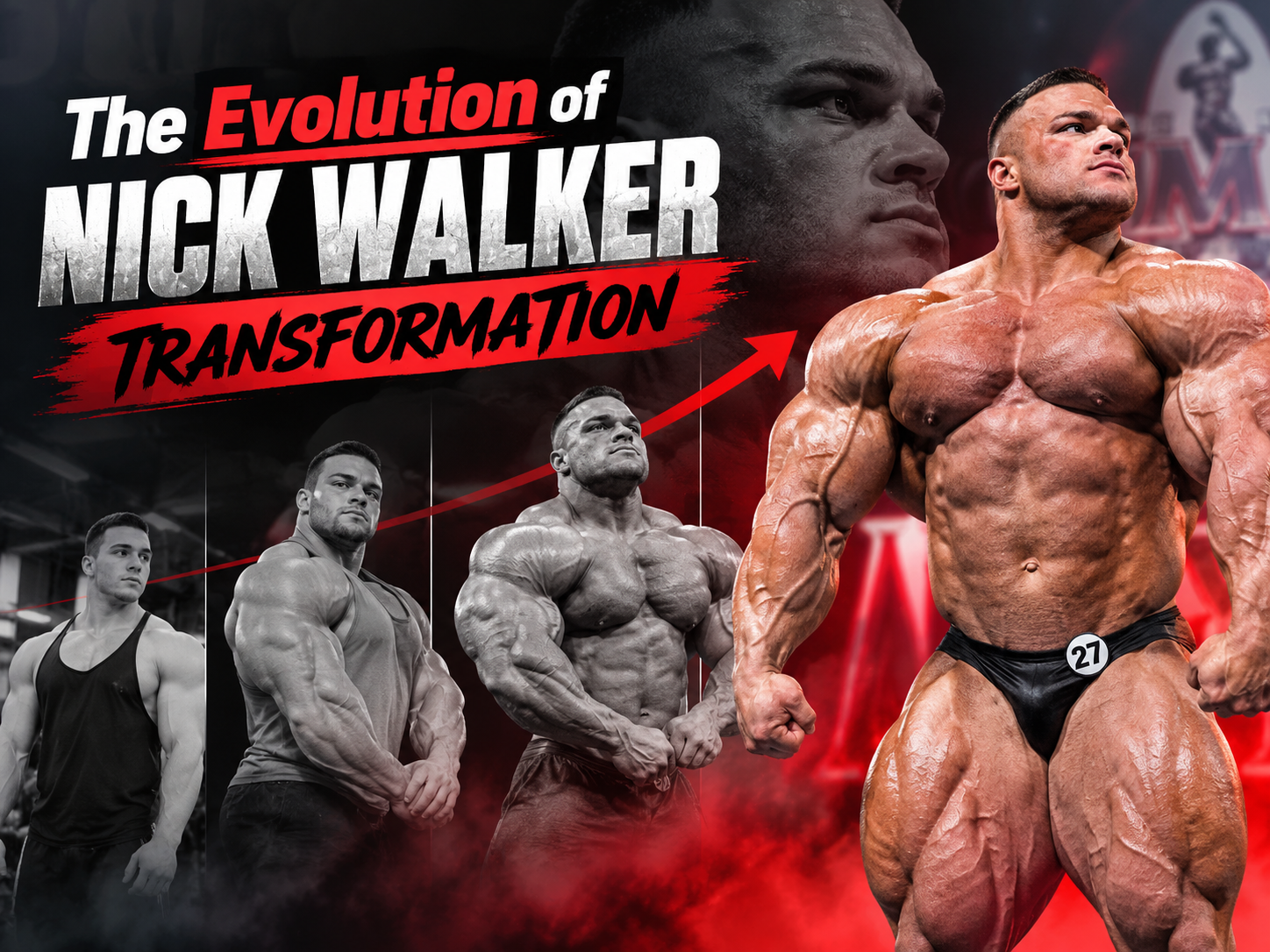
Nick Walker’s journey through professional bodybuilding is not just a story of muscle and might. It is a masterclass in resilience, reinvention, and the relentless pursuit of a goal that once seemed just out of reach. For years, fans and critics debated whether “The Mutant” could ever truly reach the summit of the Men’s Open division. In 2026, he answered that question definitively, capturing his first Sandow Trophy and cementing his legacy as one of the sport’s most compelling modern champions.
Walker’s transformation is remarkable not just for the size he has added, but for the mental fortitude he has displayed. He has navigated injuries, public criticism, and disappointing finishes to stand atop the podium in Las Vegas, proving that evolution—both physical and psychological—is the true key to greatness.
The Early Foundation: Forging a Mutant
Born on August 3, 1994, in New Jersey, Nick Walker’s introduction to bodybuilding was born out of a need for a constructive outlet. Dealing with bullying and self-image issues as a young man, he found solace and purpose in the weight room. By the age of 13 or 14, he was already adopting a mindset far beyond his years, inspired by legends like Ronnie Coleman and Jay Cutler.
Unlike many who struggle to add quality mass, Walker’s genetics and intensity allowed him to build a dense, imposing frame quickly. He was not just getting bigger; he was getting stronger. By his late teens, the raw potential was undeniable. He possessed a maturity in his musculature that usually takes decades to develop, earning him a reputation as a physical anomaly—the “Mutant” .
The Breakthrough: Conquering the Amateurs and Turning Pro
Walker’s transition from a promising amateur to a professional threat was swift and decisive. In 2020, he earned his IFBB Pro Card at the NPC North American Championships. But it was the following year that he truly announced himself to the world.
The 2021 season was a whirlwind. First, he dominated the New York Pro, showcasing a level of conditioning that was startling for a rookie. He followed this up by winning the prestigious Arnold Classic in his debut at the competition. At just 27 years old, he became the youngest winner of the Arnold Classic in 30 years, defeating a field of seasoned veterans . Later that year, in his Mr. Olympia debut, he placed an impressive fifth, signaling that a new era was on the horizon .
The Crucible: Injuries, Criticism, and the Long Road Back
If 2021 was the fairytale, the following years were the test. Walker faced a series of brutal setbacks. A torn hamstring and a calf injury forced him to miss both the 2023 and 2024 Mr. Olympia contests . During his absence, critics questioned whether his structural weaknesses—specifically a wider waist often referred to as an “H-frame”—would prevent him from ever winning the sport’s biggest title .
His return in 2025 was disappointing. He stepped on stage at the Olympia looking flat and mistimed his peak, ultimately finishing a shocking sixth place . To many, it seemed the doubters had been proven right. Walker, however, viewed it as a necessary lesson.
The Reinvention: How Walker Rebuilt His Physique
Following his 2025 setback, Walker made a radical decision: he would coach himself. He moved on from his previous team and took full control of his training and nutrition, aiming to bring a package that could finally overcome his structural critics .
Training Strategy: The Shift to Rest-Pause
To improve his conditioning without losing his trademark thickness, Walker overhauled his training intensity techniques. He shifted away from traditional drop sets, which he felt were overly taxing on his central nervous system during a caloric deficit, and pivoted to rest-pause sets .
He explained that this approach allowed him to use heavier loads for more effective reps while managing fatigue . The focus was on maintaining muscle density while chiseling away excess body fat.
Nutrition and the Waist
Walker’s diet became surgical. He kept protein intake moderate, focusing on digestion, and manipulated his carbohydrate sources to control his midsection. He swapped high-volume fruits like blueberries for more dense options like dates and raisins to reduce gastrointestinal bulk .
His goal was simple but difficult: to bring down his waist as much as his genetics would allow while maintaining the massive shoulders and arms that make him a fan favorite. He aimed to walk on stage at around 255-260 pounds, a terrifying combination of size and dryness .
2026: The Year of the Mutant
The 2026 season was Walker’s redemption tour. He opened the year with a strong runner-up finish at the Arnold Classic, proving that his new approach was working . He then secured his Olympia qualification with a win at the Tampa Pro, building momentum at the perfect time.
The 2026 Mr. Olympia Victory
The 2026 Mr. Olympia in Las Vegas was one of the most hotly contested events in recent memory. Walker faced a murderer’s row of talent: defending champion Derek Lunsford, former champion Samson Dauda, and the surging Andrew Jacked.
The battle was incredibly tight. Walker’s victory was built on an exceptional prejudging performance, where he came in with a level of dryness and density that set him apart. He earned a narrow lead that he refused to relinquish . By the final scores, Walker won with just 18 points, followed by Dauda at 20 and Lunsford at 24—a three-point spread that shows just how elite the field was .
By defeating three former Mr. Olympia champions, Walker did more than just win a title. He validated his own relentless pursuit and forced the sport to accept that a different kind of physique—one built on raw density and sheer willpower—could stand at the top .
Lessons from the Metamorphosis
Nick Walker’s evolution offers lessons that extend far beyond the gym.
Consistency Beats Talent Alone: Walker’s rise was not just about genetics. It was about showing up every day, even when the critics were loud and the injuries were painful.
Adaptability is Key: When his old methods stopped working, Walker didn’t stubbornly cling to them. He changed his training, his diet, and his coaching structure to fit his new reality .
Silence the Noise: For years, critics doubted his aesthetic. Walker absorbed the criticism, used it as fuel, and ultimately silenced the doubters with the only thing that matters—the Sandow Trophy .
Nick Walker is no longer just the promising “Mutant.” He is Mr. Olympia. And as he enters the next phase of his career, the bodybuilding world waits eagerly to see what other boundaries he will break.

