
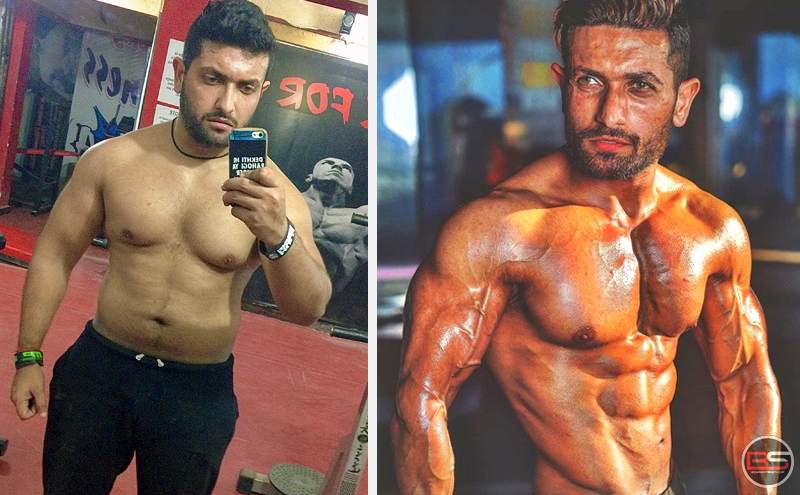
Six months is long enough to really change how you look and how much you lift. You can see it in photos, feel it in how your clothes fit, and track it in a training log. It’s not long enough to do everything at once, though. Most stalled transformations fail because the plan tries to build muscle, lose fat and run HIIT all at the same time.
This plan fixes that. You choose one goal, train in three 2-month blocks, and adjust your diet based on real numbers instead of guesses.
Step 1: Pick one goal
| Your starting point | Best goal | Calories |
|---|---|---|
| New to lifting, average body fat | Recomp (build muscle while losing some fat) | About maintenance |
| Lean, and you want size | Lean bulk | Small surplus |
| Higher body fat | Cut | Moderate deficit |
New lifters can often build muscle while losing fat, so beginners do well with a recomp. If you’re not sure where you fall, our guide to healthy body fat percentage can help.
Write down one measurable target for month six. Examples: “Squat 225 lbs for 5 reps,” “Lose 3 inches off my waist,” or “Add 10 lbs to my bench.”
Step 2: Train in three 2-month blocks
Months 1–2: Learn the lifts (full body, 3 days a week)
Focus on compound lifts and clean form. Do this workout on Monday, Wednesday and Friday:
- Squat: 3 sets of 8–10
- Bench press: 3 sets of 8–10
- Barbell or dumbbell row: 3 sets of 8–10
- Romanian deadlift: 3 sets of 8–10
- Overhead press: 2 sets of 8–10
- Plank: 3 holds of 30–60 seconds
Leave 1–2 reps in reserve on every set. You should finish each set knowing you could have done one or two more.
Months 3–4: Build volume (upper/lower split, 4 days a week)
Research shows more weekly sets lead to more muscle growth, up to a point. About 10 or more hard sets per muscle each week works well for most people. An upper/lower split gets you there without making any single workout too long.
Upper day:
- Bench press: 4 sets of 6–8
- Barbell row: 4 sets of 6–8
- Incline dumbbell press: 3 sets of 8–10
- Pull-ups or lat pulldown: 3 sets of 8–10
- Lateral raises: 3 sets of 12–15
- Biceps curls and triceps pushdowns: 2–3 sets each of 10–12
Lower day:
- Squat: 4 sets of 6–8
- Romanian deadlift: 3 sets of 8
- Leg press: 3 sets of 10
- Walking lunges: 3 sets of 10 steps per leg
- Calf raises: 4 sets of 12–15
For more lower-body ideas, see our leg day workout guide.
Months 5–6: Bring up weak points (4–5 days a week)
Stick with the upper/lower split or move to push-pull-legs. Add 2–3 extra sets a week for the body parts that are lagging behind. Supersets and drop sets can save time, but use them on the last exercise of a workout, not on your main lifts.
How to progress: double progression
Pick a rep range, like 8–10. Once you hit the top of the range on every set, add 5 lbs to upper-body lifts or 5–10 lbs to lower-body lifts, then work back up. It’s slower than adding weight every week, but it keeps working for months. To avoid the most common errors, read our list of beginner workout routine mistakes.
Step 3: Set your calories and protein
Calories. Track what you eat for a week and keep an eye on your weight. Then use these as starting points and adjust based on your weekly average weight:
- Lean bulk: add about 200–300 calories above maintenance.
- Cut: subtract about 300–500 calories. Research on natural bodybuilders suggests losing 0.5–1% of your body weight a week to hold on to muscle. For a 180-lb lifter, that’s about 1–1.8 lbs a week.
- Recomp: eat close to maintenance, and keep your protein high.
Our calorie calculator guide walks through the math.
Protein. A large meta-analysis found that protein’s effect on muscle gain levels off at about 0.7 g per pound of body weight per day. Going up to 1 g per pound is a safe buffer, especially during a cut. For a 180-lb lifter, that’s 130–180 g a day.
A simple day of eating:
- Breakfast: oatmeal with peanut butter, a banana and a scoop of whey
- Lunch: grilled chicken, rice and vegetables
- Snack: Greek yogurt with almonds
- Before your workout: a banana and coffee
- Dinner: salmon, a sweet potato and greens
For full plans, see our meal plan for muscle gain or the best bodybuilding diet to lose fat. For post-workout meal ideas, browse these protein-rich post-workout foods.
Step 4: Recover like it’s part of the plan
- Sleep at least 7 hours a night. Short sleep makes hard workouts feel harder and makes cutting harder too.
- Walk on rest days. Light movement helps recovery, and during a cut it burns calories without hurting your lifting.
- Take a lighter week every 8–10 weeks if you feel worn down. Drop your sets by about half, keep the weights, and come back fresh.
Step 5: Track what matters
- Body weight: weigh yourself most mornings and compare weekly averages, not single days.
- Waist measurement: measure every 2 weeks at your belly button.
- Photos: take them every 4 weeks, in the same lighting and the same poses.
- Strength: log every workout. If your lifts keep going up during a cut, you’re keeping your muscle.
If your weight hasn’t moved the way you planned for 2–3 weeks, change your calories by 100–200 a day and give it another two weeks.
Step 6: Make it easy to stay consistent
Motivation fades by week six for almost everyone. A routine is what carries you through. Train on fixed days, prep a few meals ahead of time, and set a small goal each month. We dig into this in discipline vs. motivation in bodybuilding.
What’s next after six months
You’ll have a training log, real data on your calories and six months of photos. If you’re ready for a more advanced program, read our breakdown of the bodybuilding transformation system. If you’re still building the basics, our bodybuilding for beginners guide covers them in more depth.
FAQ
Can you really transform your body in 6 months?
Yes, especially if you’re new to lifting. Beginners usually see the fastest changes in both strength and muscle.
Should I bulk or cut first?
If you’re new and carry average body fat, start with a recomp. If you’re already lean, go with a lean bulk. If you have more fat to lose, cut first, then build.
How many days a week should I lift?
Start with three full-body days, then move to four. U.S. guidelines recommend muscle-strengthening work at least two days a week. For building muscle, three to five days works well for most people.
How much protein do I need for a transformation?
Aim for about 0.7–1 g per pound of body weight per day.
Do I need supplements?
No. Protein powder and creatine are convenient, but food, training and sleep do most of the work.
Sources: Morton et al., protein and muscle gain meta-analysis (2018), ISSN position stand on protein and exercise (2017), Schoenfeld et al., training volume and muscle growth (2017), Helms et al., recommendations for natural bodybuilding contest prep (2014), Physical Activity Guidelines for Americans

